Strategies for successful oil seed rape cultivation

In the same way as the sowing method, targeted placement of nutrients and companion crops affect the development and yield formation of winter rape
This is why three levers of conventional oil seed rape cultivation were investigated at Gut Wambergen: the sowing method and row width, the targeted under-root fertilisation and the placement of companion seeds. The focus was on the development of the individual plant and its contribution to the future yield.

Seed row widths in winter wheat

We conducted a field trial of seed row widths in winter wheat at the Wambergen site during the 2024/2025 cultivation year. The aim was to investigate the effects of different row widths on yield formation and plant protection. Special attention was also paid to possible variety effects between a compensation type and a single ear type.

Mixed cultivation of cereals and legumes

As part of the EU-funded LEGUMINOSE project, we conducted a field trial with spring barley and field peas at our Wambergen site. The aim was to investigate the influence of sowing technology on field emergence, crop development, yield and weed pressure. We were also interested in the economic effects of mixed cultivation compared to pure stands. Mechanical weed control plays a key role here.

Sowing comparison for barley

Sowing comparison for barley: To sum up, it can be stated that the direct sowing of barley generates identical yields to those obtained in mulch sowing.

Precision Farming: Is the location-dependent use of inputs worthwhile?

Precision Farming: Is the location-dependent use of inputs worthwhile? In short: There were no discernible differences with respect to yield or quality in part-area, site-specific cultivation under the prevailing conditions – sufficient water over the entire growing season, sufficient amount of nutrients available, high disease pressure.

Field trials at the AMAZONE trials centre in Wambergen

Agriculture is only possible with commercial success in the long term. But the following is also true: There is no commercial success without sustainability, a concept which suits the local conditions and the precise and therefore more efficient use of inputs. AMAZONE is developing intelligent crop production, in order to meet these new agricultural challenges with tailored solutions.

From the Meyer-Hof to the AMAZONE intelligent crop production centre

New challenges are a constant source of difficulties for agriculture: Climate change with extreme weather, rising prices for fertiliser, fuel and labour, resistance of weeds and harmful insects, falling soil fertility, right up to ever-increasing environmental protection requirements and crop rotations adapted to the latter.

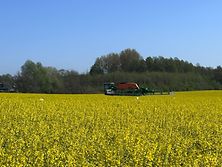
The history of the trials centre in Wambergen

Hof Meyer zu Wambergen was acquired by the Amazone Group in 2018 and, amongst other things, is now used to host the company‘s customer events. The Controlled Row Farming (CRF) project has been implemented here in conjunction with Agravis Raiffeisen and our sister company Schmotzer Hacktechnik since 2020. Trials of new agricultural practices for crops in fixed row spacings are carried out in this respect.