
Mixed cultivation of cereals and legumes
As part of the EU-funded LEGUMINOSE project, we conducted a field trial with spring barley and field peas at our Wambergen site. The aim was to investigate the influence of sowing technology on field emergence, crop development, yield and weed pressure. We were also interested in the economic effects of mixed cultivation compared to pure stands.
Trial design
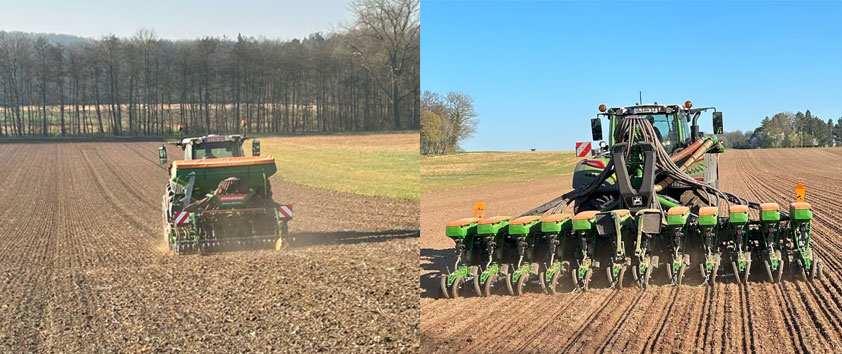
The planting was carried out in blocks using different sowing technologies. The Centaya 3000 Super with a rotary cultivator, the Avant 6002-2 with the FTender 2200 and the Precea 6002-2FCC with RoTec shares were used. Catros+ 5000-2 Pro, Cenius 3003 Special, ZA-V 4200 and the UF 1302 were also used.
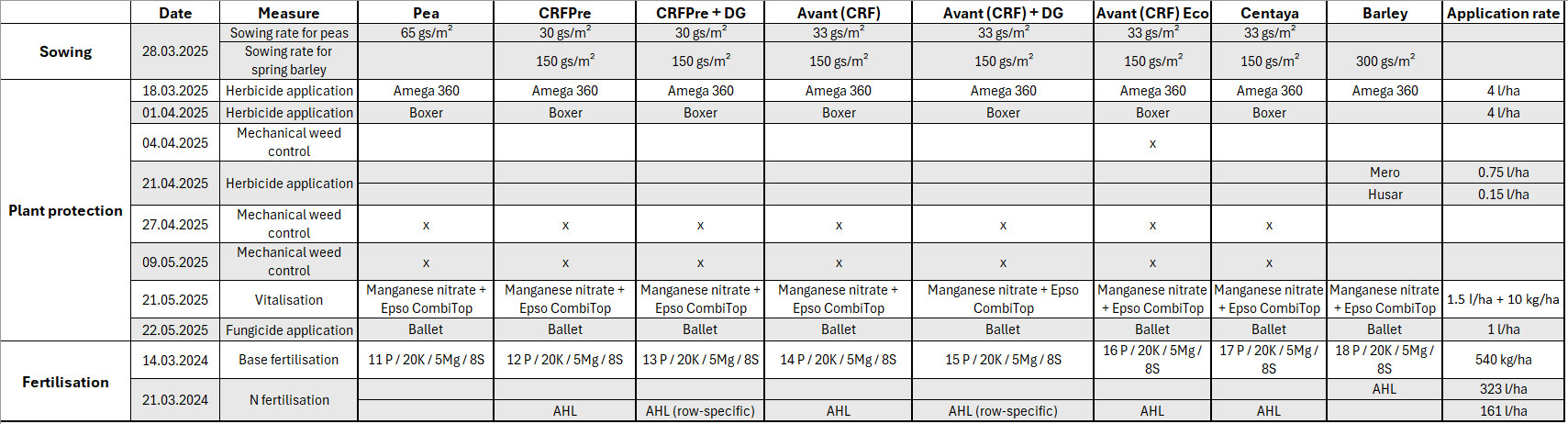
The spring barley received nitrogen fertilisation of 91 kg/ha. Fertilisation was reduced to 50% in the mixed cultivation, and the fertiliser was applied exclusively to the barley row in two variants. The seeding rate used by both partners in the mixed cultivation was 50% of the pure stand. The pea seeding rate was reduced by a further 10% during sowing with the Precea.
Field emergence and crop development
The results show clear differences between the sowing technologies used. The Precea enabled field emergence in peas to be improved by around 20% compared to the RoTec shares. Centaya impressed with excellent emergence percentages in both crops. This is due to active soil tillage during sowing, whereas all other variants were tilled with a rotary cultivator the day before. However, the improved field emergence did not immediately translate into higher yields.
Weed pressure
On the whole, the pressure from grass weeds was low. Annual meadow grass was the main grass weed, while volunteer rape was the dominant weed type. The heaviest weed pressure was observed in the purely mechanically treated variant. The soil herbicide used had some effect despite the dry weather. However, its effectiveness was severely restricted by the weather conditions.
Ripening and yield
The spring barley took on the role of supporting crop for the peas in the mixed cultivation. In the pure stand, the pea was more prone to lodging. The ripeness degree was uniform at harvest time: The peas had a moisture content of 14.7%, the barley 15.8%.
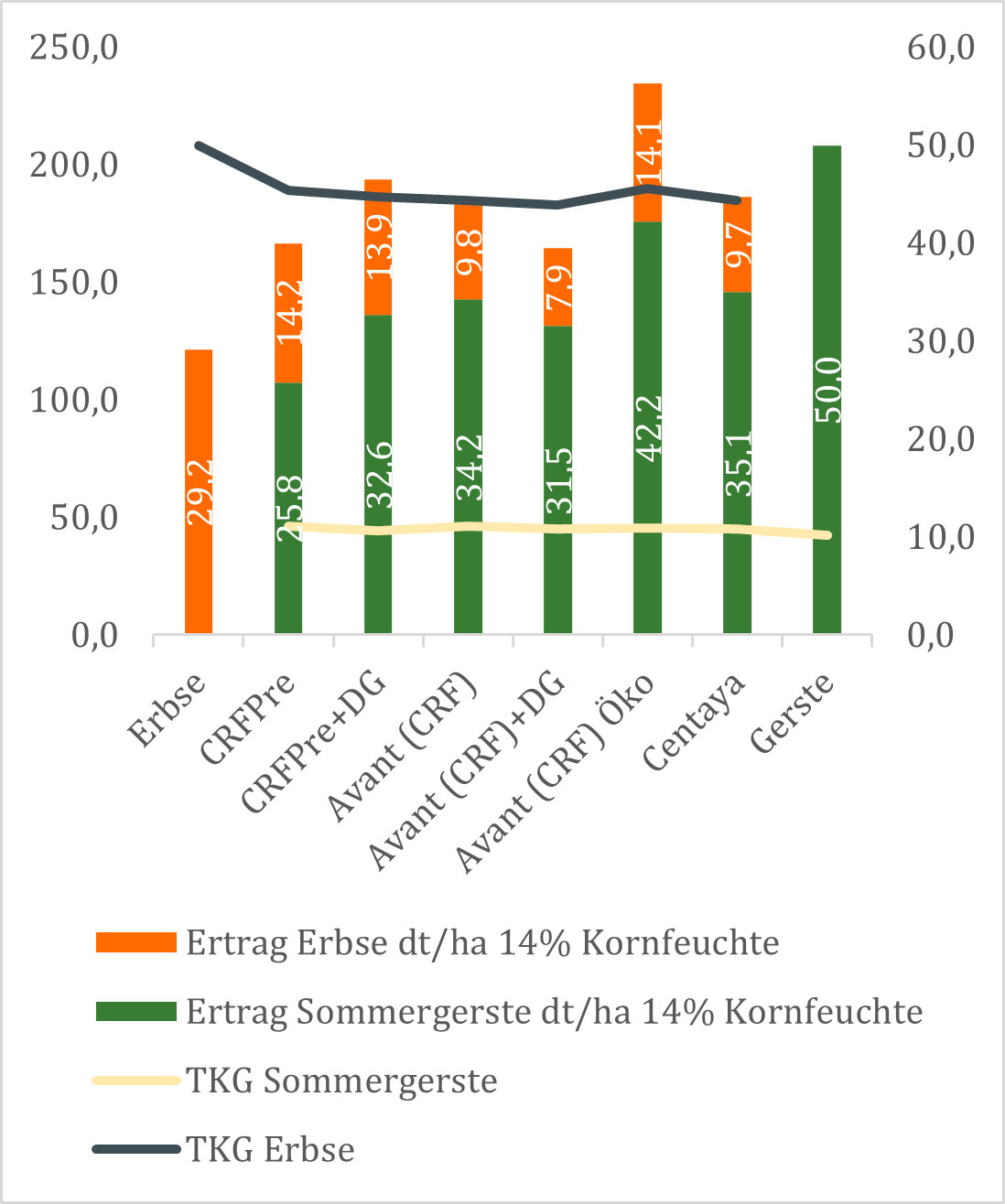
In terms of yield, the Avant Bio variant delivered the best results thanks to higher tillering. The pure pea stand produced the lowest yields, while spring barley achieved an increased yield of 21 dt/ha. Targeted N fertilisation did not result in higher yields or better quality. There was a higher proportion of peas in the yield in the Precea sowing variants.
Economic viability
All the variants examined had negative contribution margins. In this regard, the spring barley performed better than the peas. However, mixed cultivation was able to compensate for the negative contribution margin of peas by around 100 €/ha. The main reason for the unsatisfactory economic results was the cost of machinery.
Conclusion
The mixed cultivation of spring barley and field peas shows that some of the challenges associated with legume cultivation, such as the risk of lodging, can be overcome. Another aspect is that the risk of yield loss in pea cultivation can be reduced by mixed cultivation, which makes it economically more beneficial. In addition, it becomes apparent that perfect seed placement has a significant impact on field emergence. One challenge in mixed cultivation remains the limited herbicide options, as only one herbicide was possible in our case. Mechanical weed control therefore plays a key role.