
Seed row widths in winter wheat
We conducted a field trial of seed row widths in winter wheat at the Wambergen site during the 2024/2025 cultivation year. The aim was to investigate the effects of different row widths on yield formation and plant protection. Special attention was also paid to possible variety effects between a compensation type and a single ear type. In addition, provision was made for a comparison between an intensive and an extensive herbicide strategy. According to the proposal presented in autumn, the extensive strategy should involve mechanical weed control in the spring.
Weather conditions 2024/ 2025
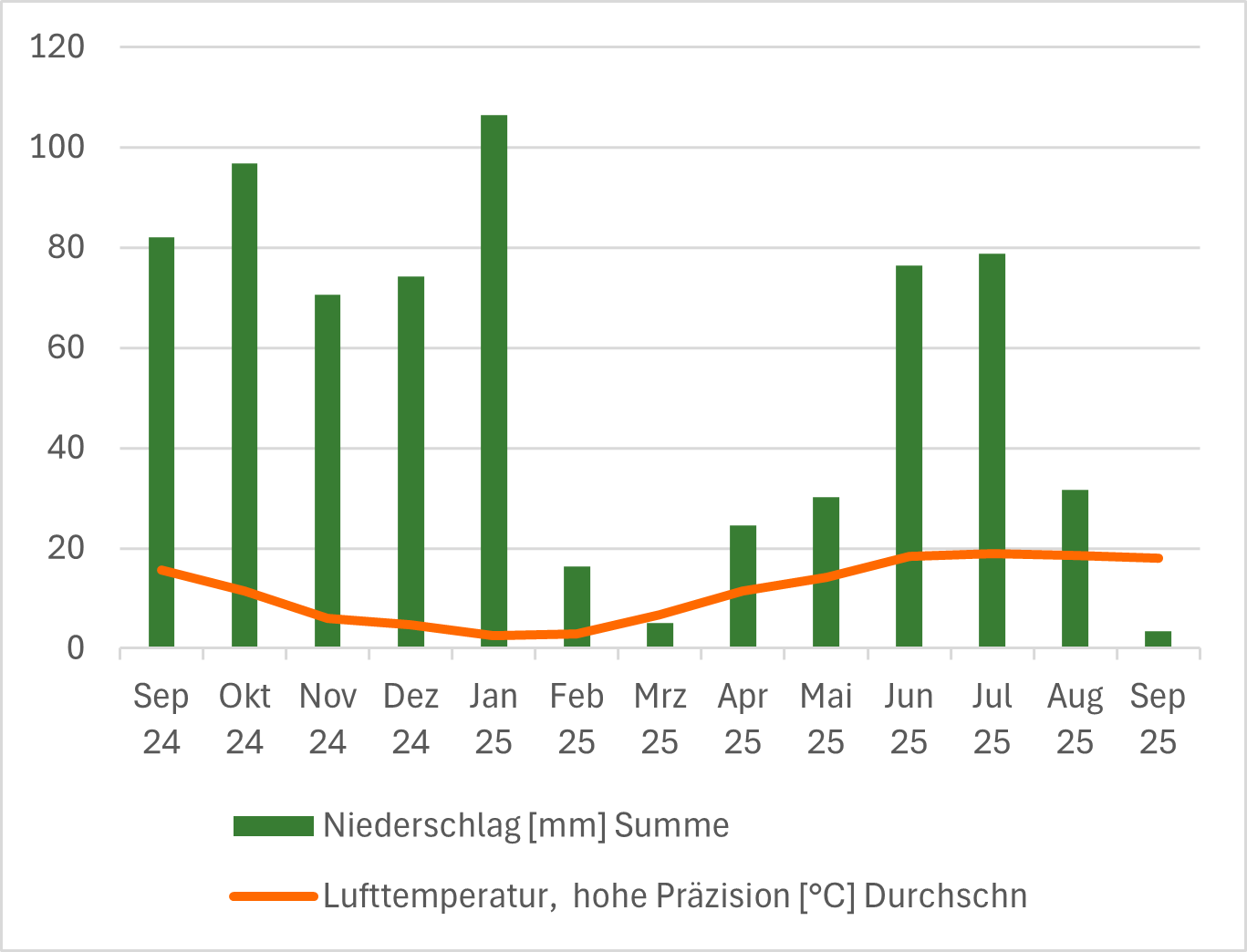
The trial season was marked by extreme weather conditions. In autumn 2024, heavy rainfall of over 50 mm during the night after sowing led to difficult germination conditions. Plant protection was not possible because the field could not be driven on. A full-area herbicide strategy was therefore implemented in the spring, meaning that no mechanical plant protection was carried out. The weather was once again wet at harvest time.
Trial procedure
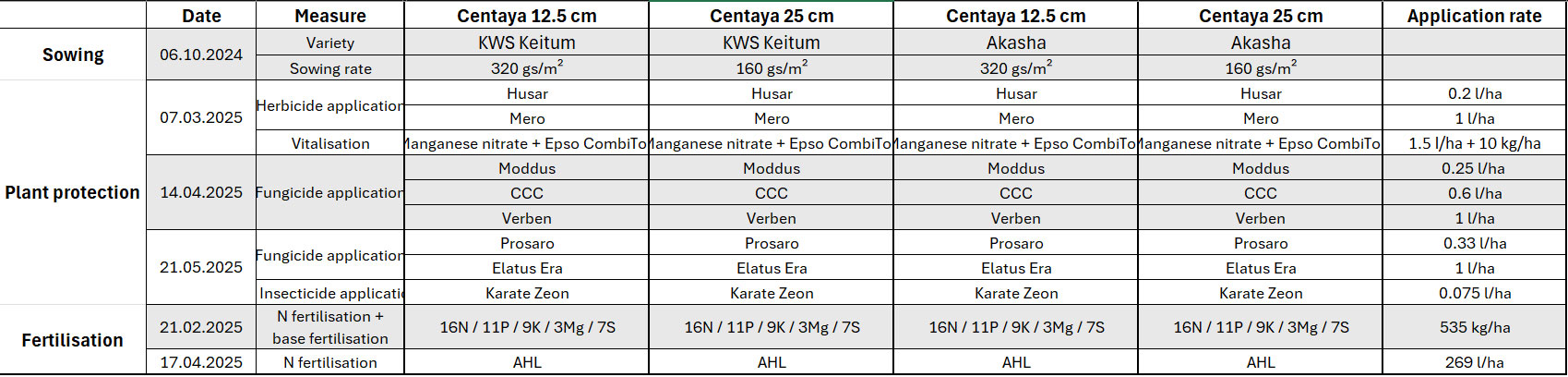
The trial was designed as a strip trial. The Cenius 3003 Special cultivator and the Centaya 3000 Super pneumatic seed drill with a KG rotary cultivator were used. A ZA-V 4200 and the UF 1302 were used for fertilisation and plant protection.
In order to investigate the variety effect on different row widths, the KWS Keitum single-ear type and the Akasha compensation type were compared. Both varieties were sown with a row width of 12.5 cm and 25 cm respectively. 320 germinable seeds were sown in the variants with the 12.5 cm row. With a row width of 25 cm, the seeding rate was reduced by 50%, so that the longitudinal distance in the row remained the same.
The crop was fertilised at the end of February with a total of 85 kg/ha N and other nutrients such as phosphorus, potash and sulphur. In addition to the data from the Spreader Application Centre, the distribution of the blended fertiliser was also checked using the EasyCheck system. Due to the weather conditions, the shoot fertiliser and the final application were combined in the form of AHL on 17/04/2025.
Trial results
The overall field emergence was at a high level, with a trial average of 91%. As expected, the number of plants per square metre was approximately twice as high in the 12.5 cm row width.
The development of the wheat crop was greatly influenced by the weather conditions. There were part-areas with a weaker water supply which suffered from water stress relatively quickly last spring. No differences could be observed between the wider and narrower rows.
It was observed that the wide row subsequently closed the rows. This was not reflected in higher weed pressure at harvest time, apart from a small patch of weeds. At the onset of the vegetation period, there was a relatively high weed and grass weed pressure over the entire field, especially from chickweed, ragwort and annual meadow grass. These were easily controlled with a herbicide application, meaning that there was no significant weed or grass weed pressure to be assessed, except for a patch of weeds in the 25 cm row width of the Akasha variety.
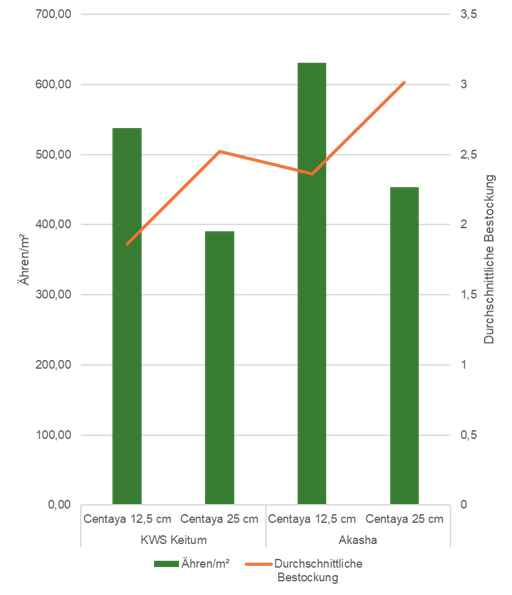
The crop development showed clear differences between the variety types. The Akasha compensation type responded with stronger tillering and was thus able to form more ears per square metre at higher row widths. The KWS Keitum single-ear type was less able to compensate for the lower crop density.
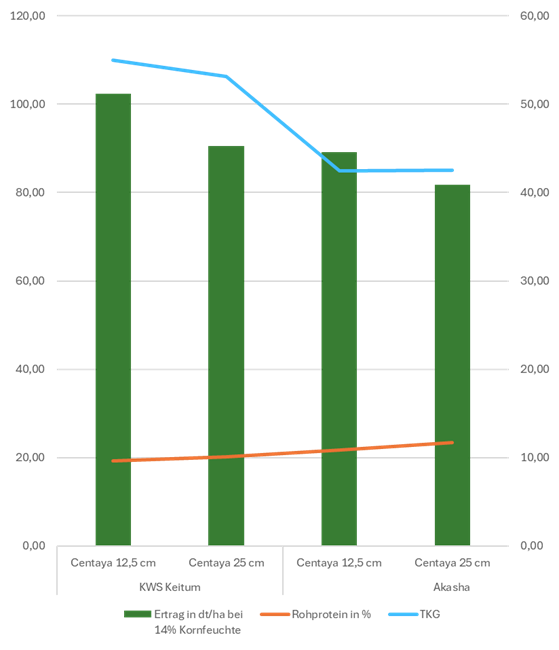
The results clearly show the following: The narrower the row width, the higher the yield. As the row width increased, the number of ears per square metre decreased, which was particularly noticeable in KWS Keitum. The Akasha compensation type was able to marginally compensate for this through stronger tillering. This explains the slightly smaller difference between the row widths of 12.5 cm and 25 cm for the Akasha variety compared to the KWS Keitum variety. The lower seeding rate could not be compensated for by higher TSW. The crude protein content decreased as the yield increased.
Conclusion
Firstly, it should be noted that the Centaya 3000 Super pneumatic seed drill performed excellently, achieving a field emergence rate of over 90% in the trial section. Close seed row widths of 12.5 cm had a particularly high yield in the 2024/2025 trial year. While the Akasha compensation type scored points with higher tillering at larger row widths, yield compensation via tillering was lower for the KWS Keitum single-ear type.
The extreme weather conditions made plant protection measures difficult, meaning that it was not possible to reduce herbicide intensity this year by integrating a hoeing machine. We will continue to test the possibility of reducing herbicide intensity in a further trial in the 2025/2026 cultivation year.