
Establishing mixed cropping with precision – every crop in the right place
Mixed cropping, companion crops and undersown crops are becoming increasingly important in modern arable farming. They improve the effectiveness of inputs, increase biodiversity and help to reduce the use of plant protection agents and fertilisers. As part of the Controlled Row Farming (CRF) project, AMAZONE has developed a technical solution that enables a wide variety of crops to be established precisely and without compromise.
Mixed cropping places new demands on the seeding systems
The aim of growing several crops on a single field is to combine the beneficial properties of different plants in a targeted manner. While legumes can fix nitrogen and provide nutrients for the following crop, companion plants protect the soil from erosion, suppress weeds and promote biodiversity. Catch crop mixes also improve soil structure and make nutrients from different depths in the soil available.
However, as diversity increases, so too do the technical demands placed on sowing. Seeds often differ significantly in terms of grain size, thousand-grain weight and shape. If all the constituents are applied together from a single seed hopper, de-mixing may occur. The result is uneven distribution and, consequently, an inconsistent plant stand.
Another crucial factor is the optimum placement depth. While large-grain legumes need to be sown several centimetres deep, fine clover varieties often only need to be sown with seed/soil contact or even on the surface. If all the constituents are sown at a single compromise depth, the germination conditions for individual crops deteriorate significantly.
Four entry points create the ideal conditions for every crop
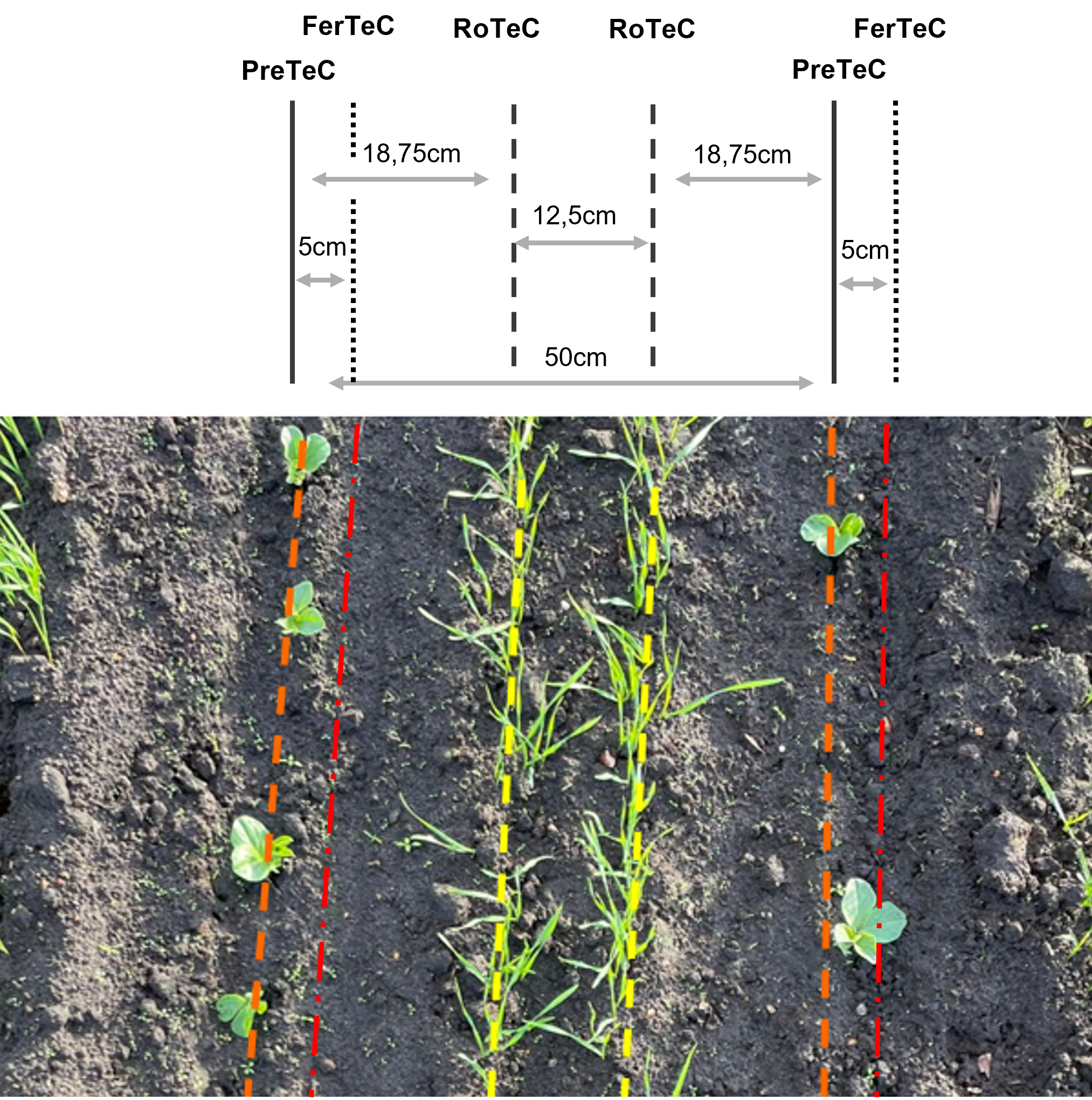
The trials machine is based on a Precea 6000-2FCC with a split FTender 2200. Compared with the standard machine, an additional seed distributor head and RoTeC single-disc coulters have been fitted to provide a further entry point. Consequently, these seed drills have four independent placement depths, which can precisely place different types of seed.
The cash crop is precision planted using the well-known PreTeC precision seeder unit. In addition, FerTeC double-disc coulters are available, which, as well as performing under-root fertilisation, can also sow large-grain seeds such as field beans or lupins.
Between the main rows there are two additional RoTeC single-disc coulters, which are specially designed for companion plants or cereals. Fine seeds, such as clover varieties, are ultimately placed directly at the optimum depth via the micro-granular applicator.
This ensures that each crop is sown at exactly the right placement depth and with exactly the right growing space required for uniform emergence. At the same time, the separate seed delivery systems prevents de-mixing within the system.
One machine – a wide range of applications
This trials machine has already been used in a variety of crops and establishment systems.
In maize, the cash crop is sown via a precision seeder, whereas undersown crops, such as white clover or other catch crops, are sown with a companion crop seeder box. At the same time, the FerTeC coulter enables precise under-root fertilisation. After the maize harvest, the catch crops help prevent erosion, fix nutrients and improve soil structure.
The system also offers new possibilities for catch crop mixes. Large-grain legumes can be sown at a greater depth, while catch crops such as phacelia, black oats or mustard are drilled at their respective optimum depths. Fine seeds are added to the mix via the micro-granular applicator.
Another area of focus involves sowing oil seed rape with companion plants. While oil seed rape is sown via the precision seeder, linseed, common bird’s foot or niger seed can be sown with a companion crop seeder box. Larger legumes are sown at their optimum placement depth via the FerTeC coulters, whereas the fine clover varieties are sown close to the surface.
This spatial separation significantly reduces the competition between the cash crop and the companion crop. At the same time, trials have shown that slightly taller companion plants can provide additional protection for young rapeseed crops against damage caused by geese.
Trial results confirm the approach
Field trials involving companion crops with oil seed rape have impressively demonstrated just how significant the impact of an optimal placement depth actually is.
As a comparison, in one variant, all the constituents were sown together at a uniform placement depth. In the second variant, each crop was sown at its specific placement depth and applied via the appropriate entry point.
The differences in field emergence were clear.
In the case of lupins, the shallower sowing depth of around six centimetres led to an increase in field emergence of around 90 per cent compared with combined sowing. Persian clover and Egyptian clover reacted even more strongly. By sowing the seed close to the surface, the field emergence rate was increased to around 210 per cent compared with the compromise variant.
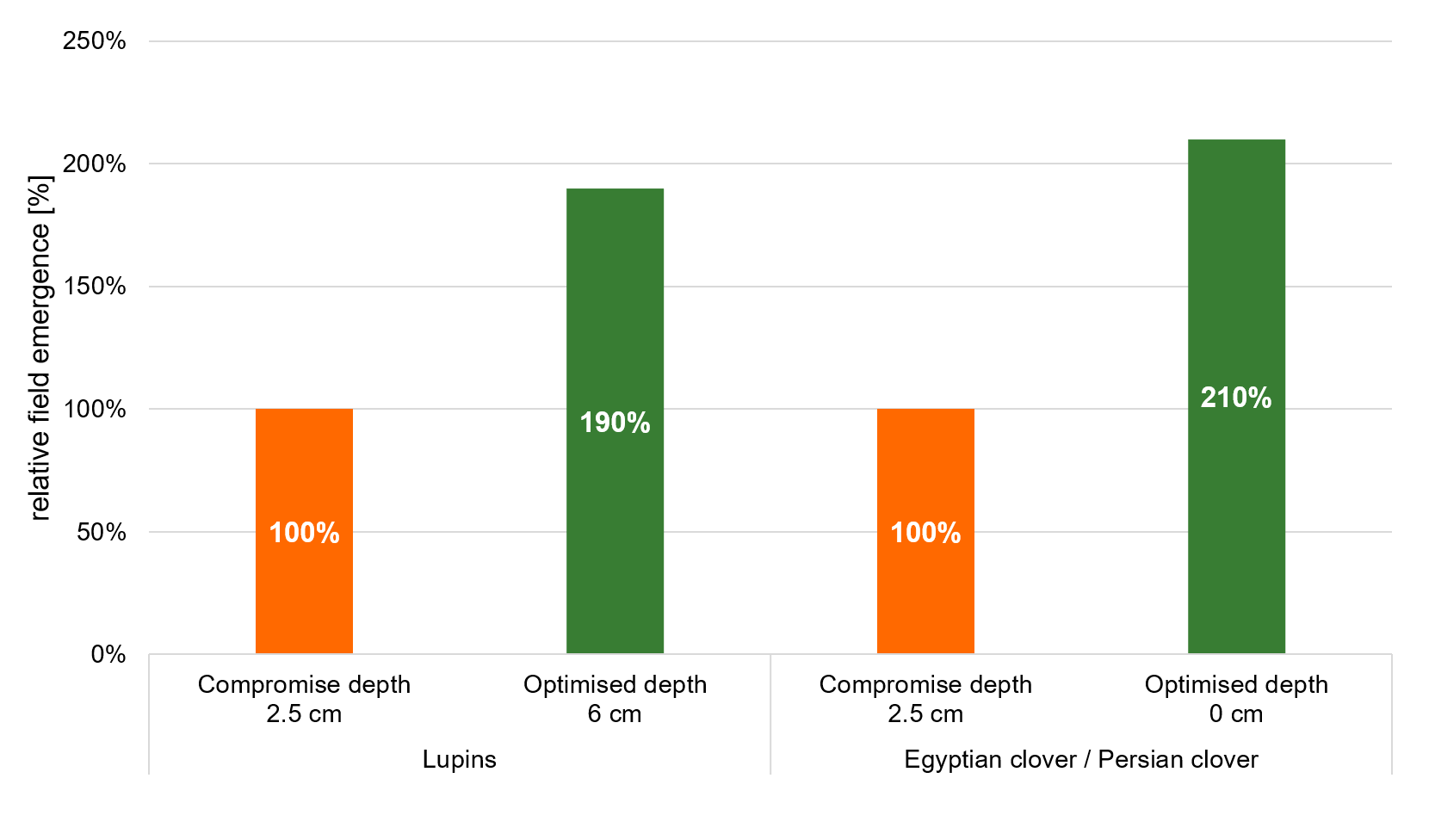
These results illustrate the impact that the correct placement depth has on field emergence. Only when each crop is placed in accordance with its specific requirements can its full potential be realised.
Summary
Diverse plant populations are regarded as a key component of sustainable arable farming. However, for mixed cropping to realise its full potential, the different requirements of the individual crops must be taken into account right from the sowing stage.
The CRF-Precea, developed as part of the CRF, demonstrates how this challenge can be overcome. Four separate entry points enable crop-specific placement without compromise. The trial results provide compelling support for this approach: Optimised field emergence, better distribution of growing space and greater flexibility create the basis for productive mixed cropping systems in conventional crop production.