
Controlled Row Farming in winter wheat
Less seed, targeted placement of N fertilisation and higher raw protein content in the 2025/26 trial
Controlled Row Farming (CRF) combines wide rows with the targeted placement of inputs. The 2025–26 winter wheat trial at Gut Wambergen investigated how halving the sowing rate, the targeted placement of mineral nitrogen fertilisation and undersown crops affect the yield and quality.
The trial is based on the results for winter barley
It has already been demonstrated in previous years that a wide row spacing for winter cereals can compensate for a considerably reduced sowing rate without resulting in any measurable yield losses. This approach was continued in winter wheat in 2025/26. The conventional variant was sown with 320 germinable seeds/m² and the three CRF variants with 160 germinable seeds/m². Base fertilisation (ZA-TS 4200) and plant protection (UF1302) were comparable in all variants; mineral nitrogen fertilisation was applied entirely as AHL. The N fertilisation was applied directly to the cereal row in one variant.
In addition to the effect of the targeted placement of N fertilisation, the main question was whether the wide row creates additional space for undersown crops and mechanical crop care. The trial therefore combines several elements of the CRF system: less seed, more precise placement of nutrients, band application of the plant protection and mechanical weed control.
Crop management: Delivery of inputs directly to the row
The wider row creates space to carry out measures in the crop in a more targeted manner. The AHL fertilisation was placed along the crop row in the designated CRF variants. At the same time, plant protection agents could be applied in bands and the spaces between the rows mechanically worked. The objective is not only a reduction in the use of individual inputs but to apply them as precisely as possible exactly where the crop needs them.
The band application of herbicides in spring in combination with mechanical weed control was very successful. No problematic weed emergence was observed in the further course of the growing season. The herbicide was applied beforehand with the UF1302 at the optimum time, and the weeds mechanically controlled with the Venterra 1K a short time later.
The granular fertiliser was applied with a ZA-TS 4200 and the liquid fertiliser and plant protection with a UF1302. In addition to the mechanical weed control, undersown crops were also sown with the Venterra 1K. The standard baffle plates were used for the application.
Undersown crops: The cultivation concept only works if the plants are firmly established
The additional space between the wheat rows should also be used for undersown crops. White clover with 3 kg/ha was planned for the autumn. However, the crop did not establish owing to very high rainfall. A second attempt in the spring failed under the opposite conditions: a pronounced period of drought followed after sowing, meaning that the young plants shrivelled up.
As a result, the effect of an established undersown crop could not be evaluated in the trial year 2026. At the same time, the result demonstrates how much the success of such systems depends on the correct sowing date and an adequate water supply. The technical possibility of placement is not enough on its own - the undersown crop must be able to reliably emerge under the respective field and weather conditions.
Yield and quality: lower yield but considerably more raw protein
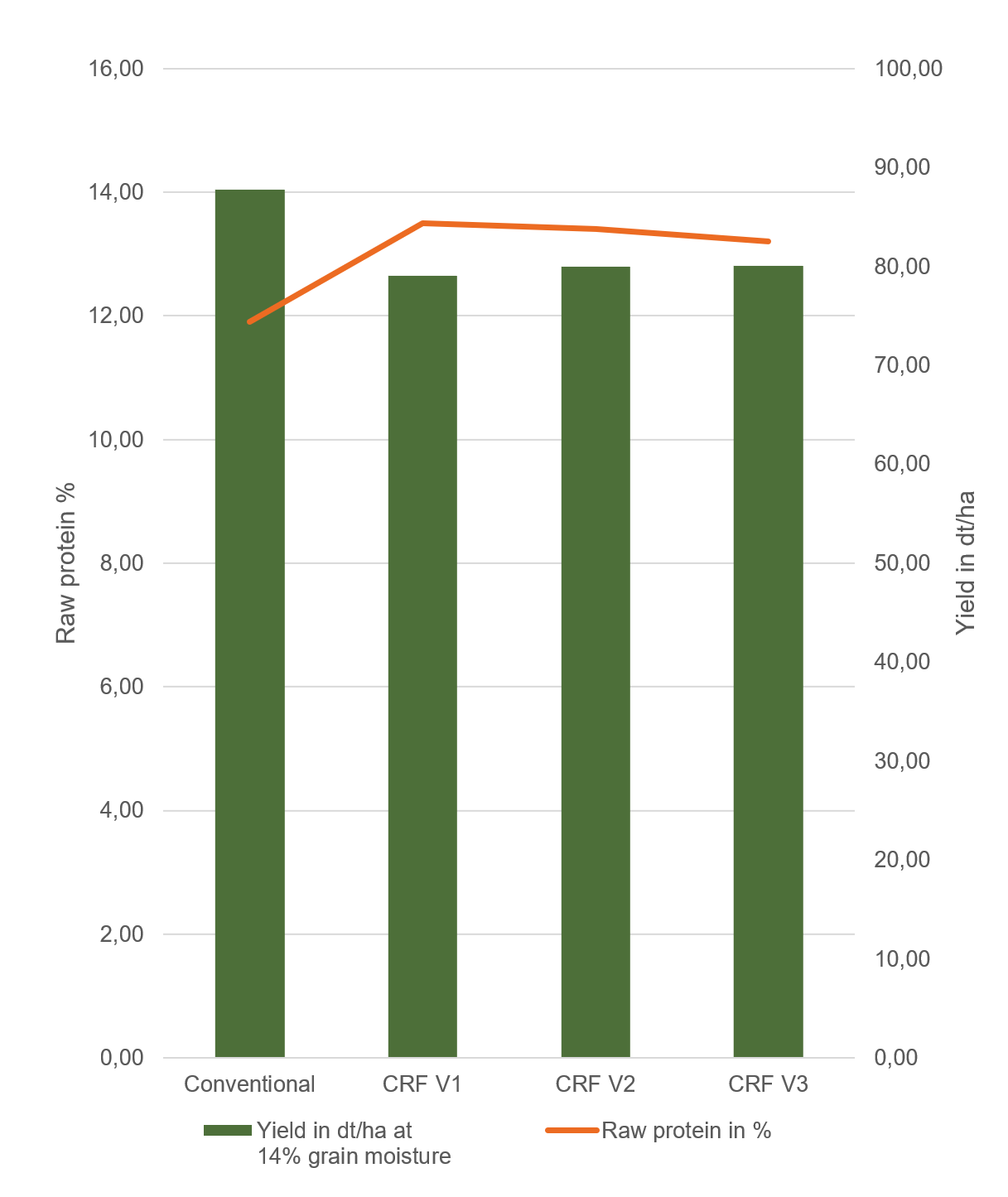
The conventional wheat provided the highest grain yield at harvest with 87.8 dt/ha. The three CRF variants were below this with around 79 to 80 dt/ha. The revised trial evaluation estimates the yield advantage of conventional cultivation to be around 8 %. All yields are based on a grain moisture content of 14 %.
The results were different when it came to grain quality. The raw protein content was 11.9 % in the conventional cultivation. 13.2 to 13.5 % was achieved in the CRF variants – an increase of around 1.3 to 1.6 percentage points. At the same time, there was no discernible impact of the N fertiliser placement on yield or raw protein content in the CRF variants.
The crop compensation has limits
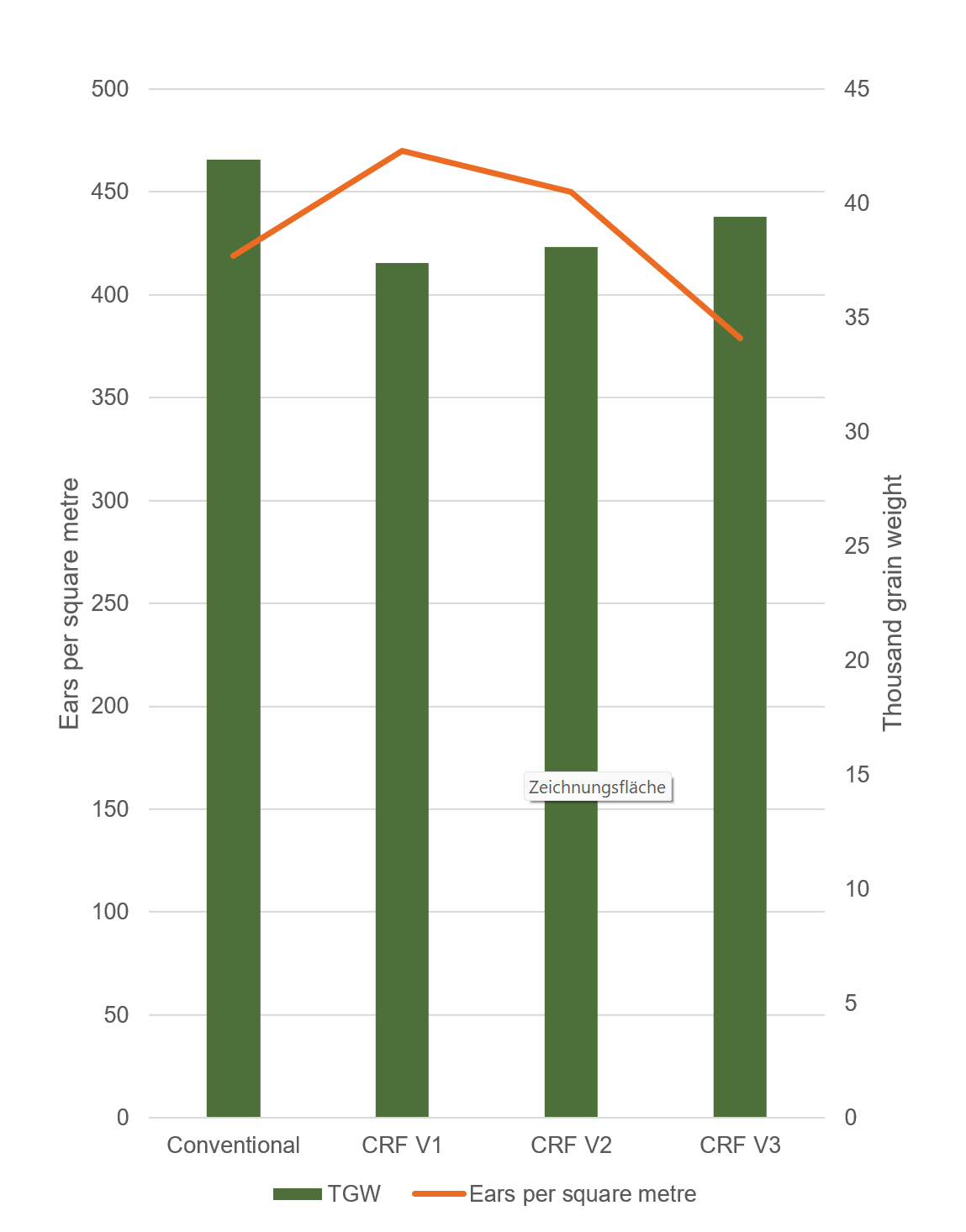
The yield components explain the differences: In spite of a sowing rate reduced by 50%, the CRF variants produced 379 to 470 ears/m² and therefore compensated for the lower seed rate. The conventional variant produced 419 ears/m².
The thousand grain weight was 41.9 g in the conventional cultivation and 37.4 to 39.4 g in the CRF variants. This shows the impact of the period of extreme heat in July which stopped grain filling. The CRF crops were less developed at this point. In addition, other factors may have had an impact, such as the strong solar radiation on the unshaded soil between the wide rows, which led to increased evaporation.
What can be learned from the trial?
Winter wheat at Gut Wambergen before the harvest. The 2025/26 winter wheat trial demonstrates that halving the sowing rate in the CRF system could be largely compensated for through good crop development. However, the conventional cultivation remained ahead in terms of yield at harvest, while the CRF variants achieved higher raw protein contents. There is a need for further investigation into which variety type works best in a wider row or whether the weather conditions are the main reason for the yield disadvantage. At the same time, it should be noted that the wide row system worked very well in winter barley without any yield disadvantage (cf. article: Trial report on winter barley – wide rows and better N fertiliser efficiency).
The mechanical weed control in spring proved to be very effective, meaning that herbicide use could be reduced by 50%. A firmly established, precisely placed undersown crop helps to cover the soil between the rows and influence the microclimate within the crop and also promote soil life. Further trials are needed to determine whether this will help stabilise the yield. A research project will be conducted over the next few years to explore how this can be achieved.